Animal Behavioral Sciene , Training Techniques, Anxiety Aggression Fear, Behavior Modification
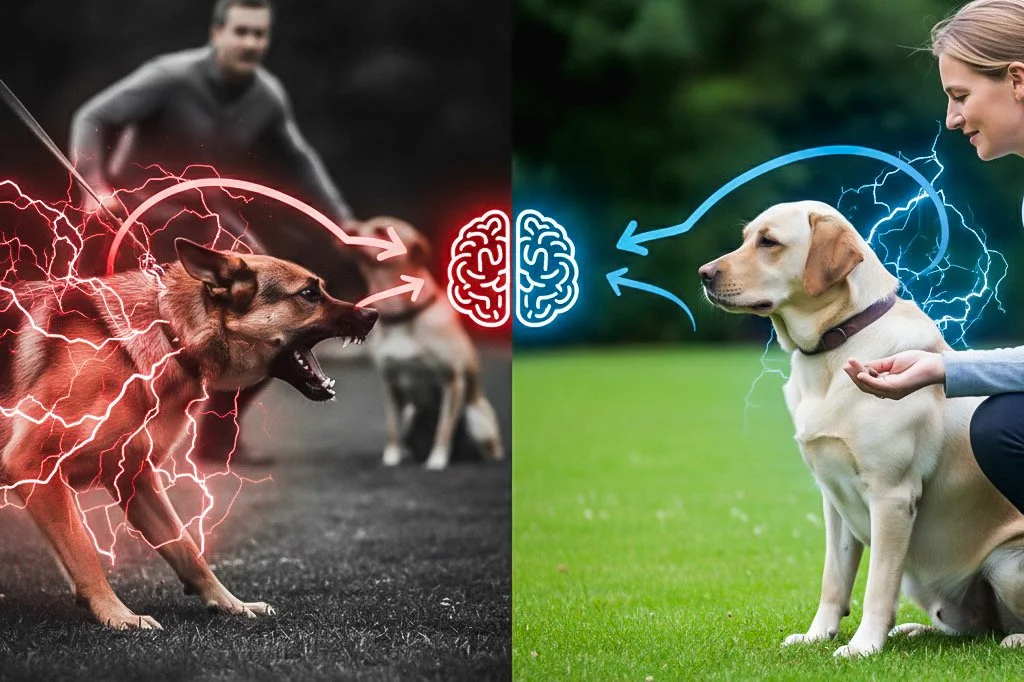
The most catastrophic misdiagnosis I see in my work is the conflation of reactivity with aggression. One is a physiological reflex; the other is a learned strategy. In this article, I dissect the critical neurological difference between what I call the Primal Mind—the reflexive, amygdala-driven survival system—and the Cognitive Mind, which is the prefrontal cortex, the center of decision-making and intention. A reactive dog is a dog whose Primal Mind has hijacked its nervous system, often due to a high allostatic (stress) load, leaving it drowning in cortisol and unable to access its 'thinking' brain.
I also explore the tragic slide of how chronic, unmanaged reactivity becomes learned aggression, and how the handler's own nervous system—our own stress and tension—creates a devastating neuroceptive feedback loop that co-regulates our dog's panic. Understanding this biology is not academic; it is the only way to formulate a correct intervention. I provide the specific neurological protocols for both: how we rewire the Primal Mind's emotional association using counter-conditioning, and how we reroute the Cognitive Mind's learned strategy using a combination of differential reinforcement and safe, non-confrontational negative punishment. This is the science of moving from chaos to clarity.
The debate over whether crate training is a beneficial practice or a cruel imposition cannot be resolved with a simple, universal answer. The scientific evidence demonstrates that the crate's impact on a dog's welfare is not an inherent quality of the object itself but is determined entirely by the context of its use—a context created and controlled by the human guardian. A dog's actual experience of the crate is a tangible neurophysiological event, governed by a constant balance between the sympathetic nervous system's threat response and the parasympathetic nervous system's state of safety and calm. The tipping of this balance is dictated by the principles of learning theory. Through careful, positive classical conditioning, the crate can become a conditioned stimulus for relaxation. Through misuse, punishment, or force, it becomes a potent trigger for fear, anxiety, and potentially, the pathological state of learned helplessness.
In this article I will try to explain how these opposing outcomes are not a matter of chance, but are the predictable results of specific, measurable factors. By deconstructing the popular but flawed "den animal" analogy through the lens of wild canid ethology, examining the brain's threat-detection and safety circuits, and applying the fundamental laws of associative learning, I will build a clear, evidence-based framework. This framework will empower guardians to move beyond the simplistic "good versus cruel" debate and instead focus on what truly matters: creating a context of profound safety for their canine companions.
Ultimately, the crate serves as an amplifier, magnifying the qualities of the dog's broader environment. In a life characterized by predictability, enrichment, and security, a crate can become a congruent extension of that safety—a personal sanctuary. 🧘 In a life of chaos, unpredictability, and unmet needs, it becomes a cage that confines the dog with its ambient stress. Therefore, the ethical and practical utility of a dog crate is entirely dependent on the knowledge, skill, and empathy of the individual who wields it. The responsibility for the outcome—a calm, confident dog that views its crate as a safe haven, or a fearful, anxious animal trapped in a state of distress—lies not with the tool, but exclusively with the user.
Bart De Gols

Drive is biology, not behavior. It is the expression of genetic programming etched into a dog’s nervous system and refined through centuries of selection. When I see people trying to suppress drive with harsh methods or deprivation, I don’t see training—I see trauma. The science is clear: suppression elevates cortisol, shuts down dopamine, and erodes neuroplasticity. The dog may look calm on the outside, but what I often see is learned helplessness—the quiet of defeat, not the balance of fulfillment.
In this article, I explain why suppression is abuse, and why fair, mild corrections, used only after drive has been properly channeled, are not cruelty but part of biology itself. My work is about engagement, mental stimulation, and breed-specific outlets that respect the dog’s genetics while building partnership. True training isn’t about erasing drive. It’s about harnessing it with purpose while keeping the spark of the animal alive
In this article, I share the story of Bennie, a magnificent German Shepherd taken by a cruel, deceptive cancer called cutaneous lymphoma. His journey serves as a chilling warning about a silent threat lurking in plain sight: the chemical cocktails of herbicides and pesticides used to create perfect, green lawns. Known as "The Great Mimicker," this cancer often masquerades as a simple skin allergy, leading to a heartbreaking cycle of misdiagnosis while the disease silently advances. Our dogs, living their lives nose-to-the-ground, have become the unwilling sentinels for the toxins in our shared environment, and their suffering is an alarm we can no longer ignore.
Bennie’s memory calls us to a higher standard of stewardship. The information in this article is meant to empower you to become a fierce advocate for your pet in the vet's office, questioning a recurring "allergy" diagnosis and pushing for a biopsy when something feels wrong. More fundamentally, it demands we rethink the world we create for them. By eliminating cosmetic pesticides from our own yards, wiping paws after walks in public parks, and demanding safer community spaces, we can fight this disease before it ever starts. Bennie’s legacy asks us to choose health over the illusion of synthetic perfection, protecting the animals who trust us with their lives.

In my decades of work as a cynologist, no concept has proven more pervasive, nor more fundamentally misleading, than that of "distraction." It is the universal scapegoat for a lapse in connection, the label we apply when a dog’s attention strays from our intended path to a squirrel, a scent, or a sound on the wind. We frame it as a failure of focus, a moment of willful disobedience. But after countless hours observing the intricate dance between human and canine, and immersing myself in the neuroscience that governs it, I have come to see this interpretation for what it is: a profound delusion. The dog that turns away is not broken, nor is he defying you. He is, in fact, operating flawlessly according to a biological imperative far more powerful than our desire for compliance.
This article is an invitation to join me in a paradigm shift—one I call The Salience Shift. We will move beyond the flawed language of distraction and into the precise world of motivational neuroscience, where we learn that attention is a currency allocated only to what the brain deems most salient, or motivationally relevant. Your dog is not ignoring you; he is making a valid neurological choice to engage with a stimulus that has, in that moment, won the auction for his attention. Our task, then, is not to suppress the world, but to change our place within it. We will journey through the architecture of the canine mind to answer the most critical question in training: not "How do I stop my dog from being distracted?", but "How do I become the most salient, rewarding, and engaging phenomenon in my dog’s world?