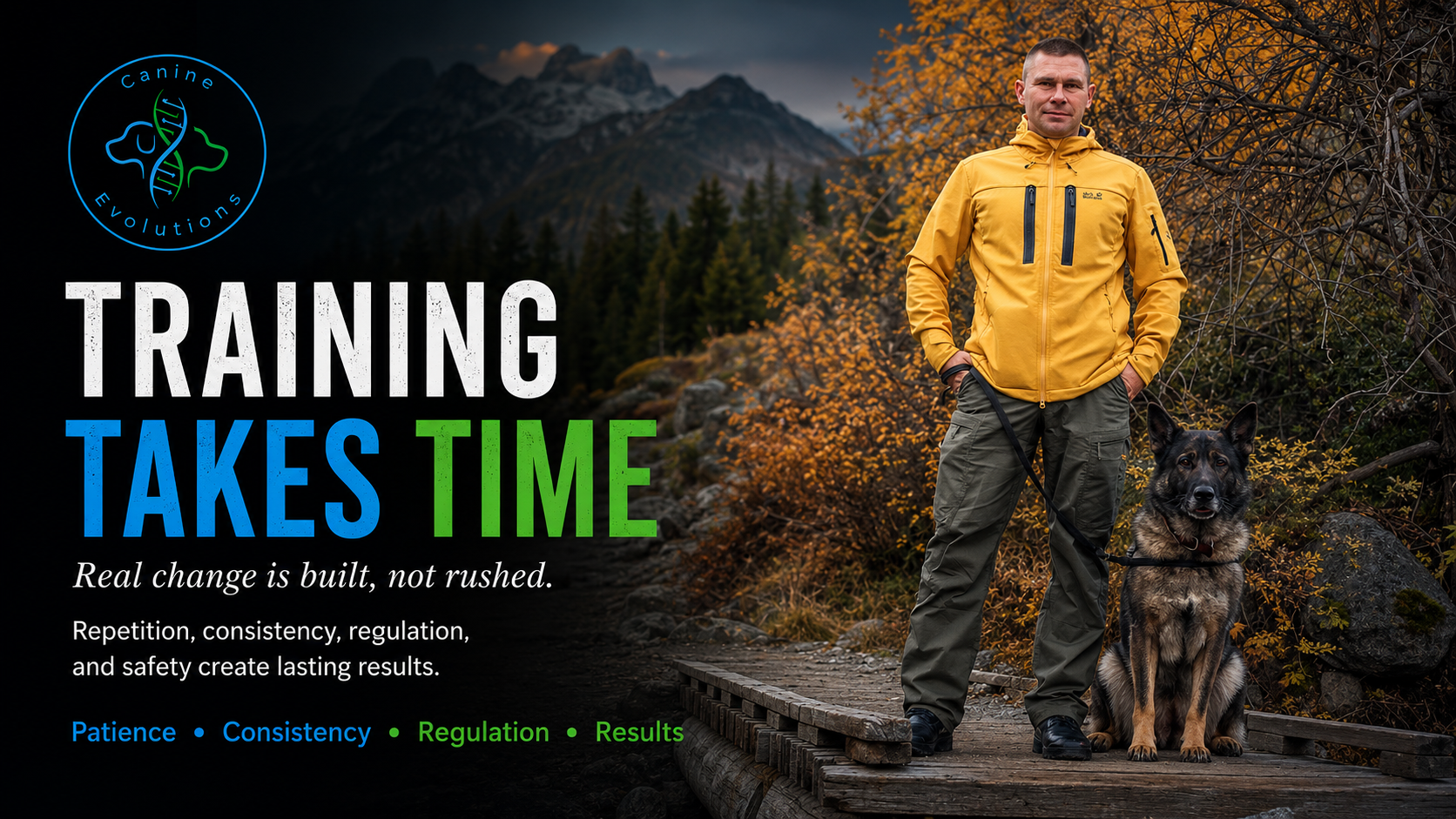
Real Change Takes Time
When you’re living with reactivity, anxiety, aggression, fear, or a dog that feels unpredictable, time is not an abstract concept. It’s the thing you don’t have. It’s the thing you’re running out of. It’s the thing that gets stolen from your nervous system every time the leash tightens, every time the doorbell rings, every time you step outside and you don’t know what’s going to happen.
So let me be direct: I understand why people want fast results. Most owners aren’t impatient. They’re exhausted.
But there is a difference between a dog that can perform a behavior for a moment and a dog that has actually changed. Real change isn’t just “the dog did it.” Real change is the dog doing it when life is loud, when stress rises, when the environment is unpredictable, when your own body is tense, when the old patterns are begging to return.
That kind of change takes time, not because you are failing, and not because your dog is broken, but because the nervous system doesn’t rewrite itself in one session. It rewires through repetition, consistency, and safety.
Why the Timeline Matters
Training that looks impressive in a short window is often fragile. It can collapse the moment pressure returns.
A dog that is anxious, reactive, aggressive, phobic, or traumatized is not just “misbehaving.” That dog is often living too close to survival. And a dog in survival can still move, still bark, still lunge, still comply, still shut down… but it is not learning in the way people think it is.
Our job is not to rush the dog through a trigger. Our job is to build capacity. To build recovery. To build stability. To build a dog that can return to a thinking state when life challenges them.
And that is a layered process.
Step One Is Always the Same: See the Whole Picture
Before we talk about commands, tools, or packages, we need to know what we’re dealing with.
That means looking at the dog’s stress patterns, triggers, intensity, and recovery. It means looking at the environment that keeps the behavior alive. It means looking at handling—timing, pressure, mechanics, and consistency—because the human is part of the system.
When this step is skipped, people pay twice. They spend money on training that “kind of worked,” and then they spend money again when the behavior returns in a new shape.
Clarity in the beginning is what prevents wasted time later.
Dogs Don’t Change in Straight Lines
Progress rarely looks like a clean staircase. Especially in behavior cases.
Some days will feel like a breakthrough. Some days will feel like nothing moved. Some days will feel like you went backward. That is not failure. That is the nervous system adjusting under real life stress, and the dog testing whether this new pattern is truly safe enough to trust.
The goal is not perfection. The goal is trajectory.
We reduce rehearsal. We lower the dog’s baseline stress. We teach new patterns at the edge of what the dog can handle. We increase challenge only when the dog shows real stability—not when the human is simply ready to “push it.”
That is how confidence is built without flooding. That is how a reactive dog becomes a dog that can recover.
Consistency Beats Intensity
One session a week cannot override a household that rehearses the old pattern every day.
The biggest factor in lasting change is not what happens in front of me for an hour. It’s what happens in your real world between sessions. That’s why my work includes human education. Not because I want you to become a trainer—because you need the ability to recognize what’s happening early, respond correctly, and stop feeding the very cycle you’re trying to fix.
Small reps. Clean reps. Repeated over time. That is where the nervous system starts to shift.
The Plan Evolves as the Dog Evolves
A good plan doesn’t stay the same for months.
As your dog becomes more stable, the plan changes. As triggers shift, the plan changes. As the dog’s capacity grows, we add complexity. As life changes—new environments, new routines, new stressors—we adjust the structure so the progress holds.
That’s what real training is: not a single technique, but a guided progression.
What This Means for You
If you’re looking for a quick fix, you will probably find someone who will sell you one.
If you want lasting change, the path is different. It’s steadier. It’s more honest. And it’s built around the reality that a dog’s behavior is not a light switch.
The upside is this: when you do it correctly, the change is not fragile. It holds. It doesn’t disappear the moment life gets loud.
If you’re ready to begin, start with an evaluation so I can see the full picture and recommend the right path forward.