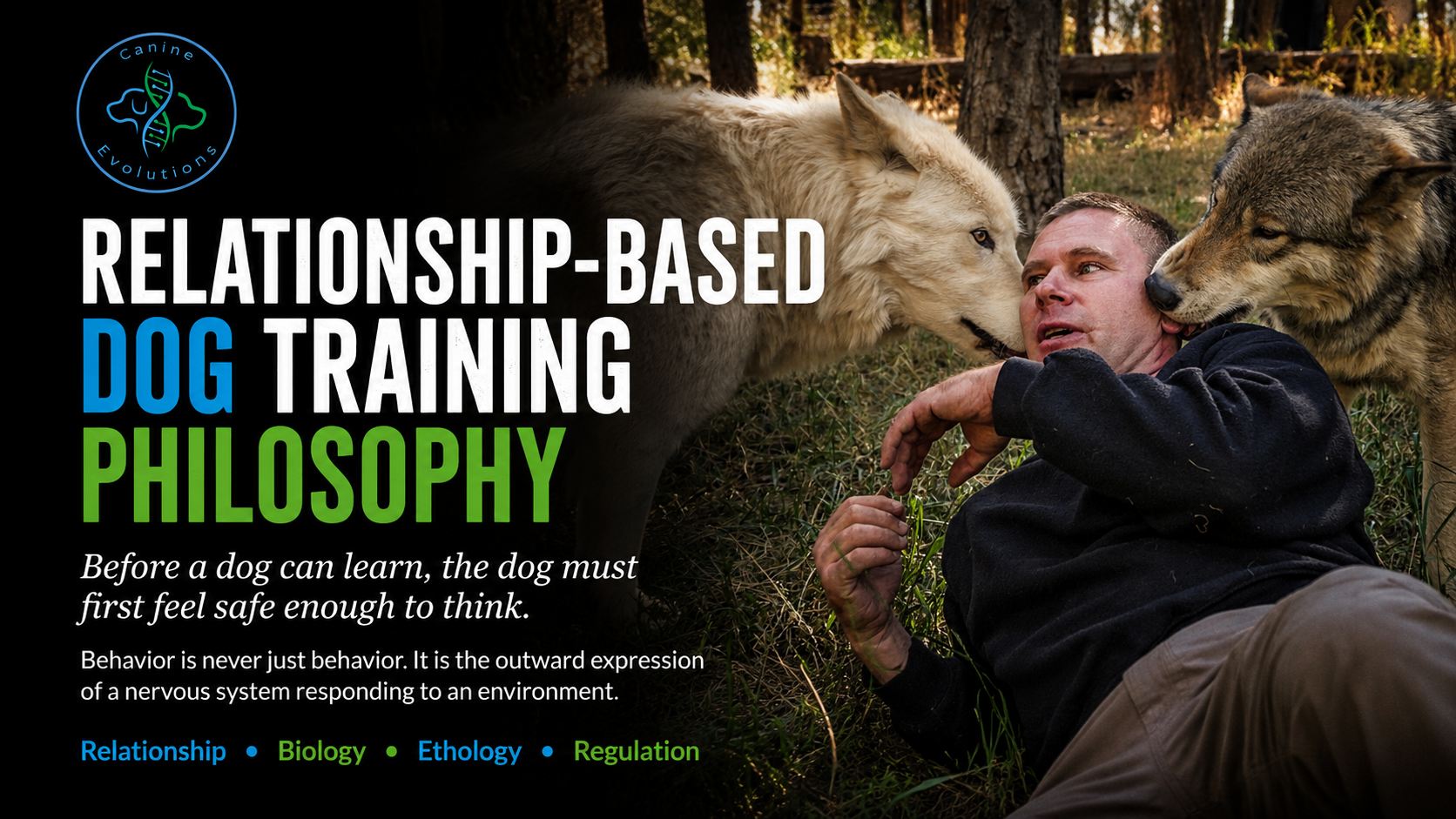
Relationship-Based Dog Training at Canine Evolutions
Over the last 30 years I have studied and worked with dogs in nearly every training system you can name. I found useful elements in many of them—and I also found a recurring problem they all share:
They try to change the dog’s behavior without first changing the relationship and the state the dog is living in.
A dog can comply because it is avoiding something. A dog can comply because it wants the food or the toy. But neither of those is the same as a dog who is regulated, connected, and able to think.
At Canine Evolutions, I do not teach “a method.” I teach a relationship-based lifestyle rooted in cynology, ethology, behavioral science, and neurobiology—because behavior is never just behavior. It is the outward expression of a nervous system responding to an environment.
Before a dog can learn, the dog must first feel safe enough to think.
The Three Pillars Behind My Work
My newest publications and teaching are built around three connected lenses. They are not separate ideas—they are one system seen from three angles.
1) The Space Between Minds
This is the foundation: the relationship itself.
Dogs don’t meet us at the level of language first. They meet us at the level of biology. They read breath, posture, muscle tension, rhythm, intention, and micro-movement—often before we are aware we are broadcasting anything at all.
This is where concepts like emotional contagion and limbic resonance come in. In plain terms: dogs are extraordinarily sensitive to the emotional and physiological state of the humans they live with. When we are tense, braced, anxious, unpredictable, or internally rushed, the dog often cannot settle—because the environment (us) is not stable. When we become coherent—calmer, clearer, more predictable—the dog’s nervous system can soften enough to enter a learning state.
Relationship is not sentimental here. It is structural. It determines what the dog experiences every day, and it determines whether training becomes a clean learning process or a constant struggle for control.
2) Through the Eyes of the Wolf
This is the ecological lens: the dog in the modern world.
Dogs are not wolves. They are a different species shaped by domestication, selective pressure, and life alongside humans. But dogs did not arrive as blank slates. They inherited a large amount of evolutionary hardware: social sensitivity, scent intelligence, movement patterns, predatory sequence fragments, territorial awareness, and a nervous system designed to survive through accurate perception.
What changed is the world.
Many “behavior problems” are not random, not unprovoked, and not mysterious. They are often the predictable results of modern environmental pressure: constant stimulation, lack of rhythm, lack of recovery, confinement, frustration, crowded spaces, chaotic routines, and the loss of natural regulation.
Understanding ethology doesn’t excuse behavior. It creates accuracy. And accuracy is the beginning of change.
3) The Regulated Human
This is the human lens: the variable most training models ignore.
Owners often arrive exhausted, after trying mechanics—treats, tools, protocols, corrections, scripts and commands thrown into stress. Then they watch the dog soften within minutes when I take the leash, and they ask the same question: “What did you just do?”
The answer is rarely found in the hands. It is found in the body.
Dogs respond to the biological truth of the human in front of them—frame, breath, tension, timing, pressure, predictability. Regulation is not a personality trait. It is a discipline. And it is the gateway to the dog’s cognitive mind.
Dogs Are Not Wolves—But They Are Not “Stuffed Animals” Either
Wolves are not dominance machines. They are family systems. Parents teach. Leaders stabilize the group. The pack is held together by structure, predictability, and shared state—not constant violence.
Dogs are not wolves. But they are still social mammals with an inherited sensitivity to movement, pressure, and emotional field. They still respond to clarity. They still respond to instability. They still organize their behavior around what feels safe, predictable, and coherent.
Where modern training often goes wrong is in the extremes:
Some approaches rely on force and control, confusing fear with respect.
Others rely only on rewards, never building true leadership, structure, or resilience.
My work lives in a different place: relationship, clarity, responsibility, and honest biology.
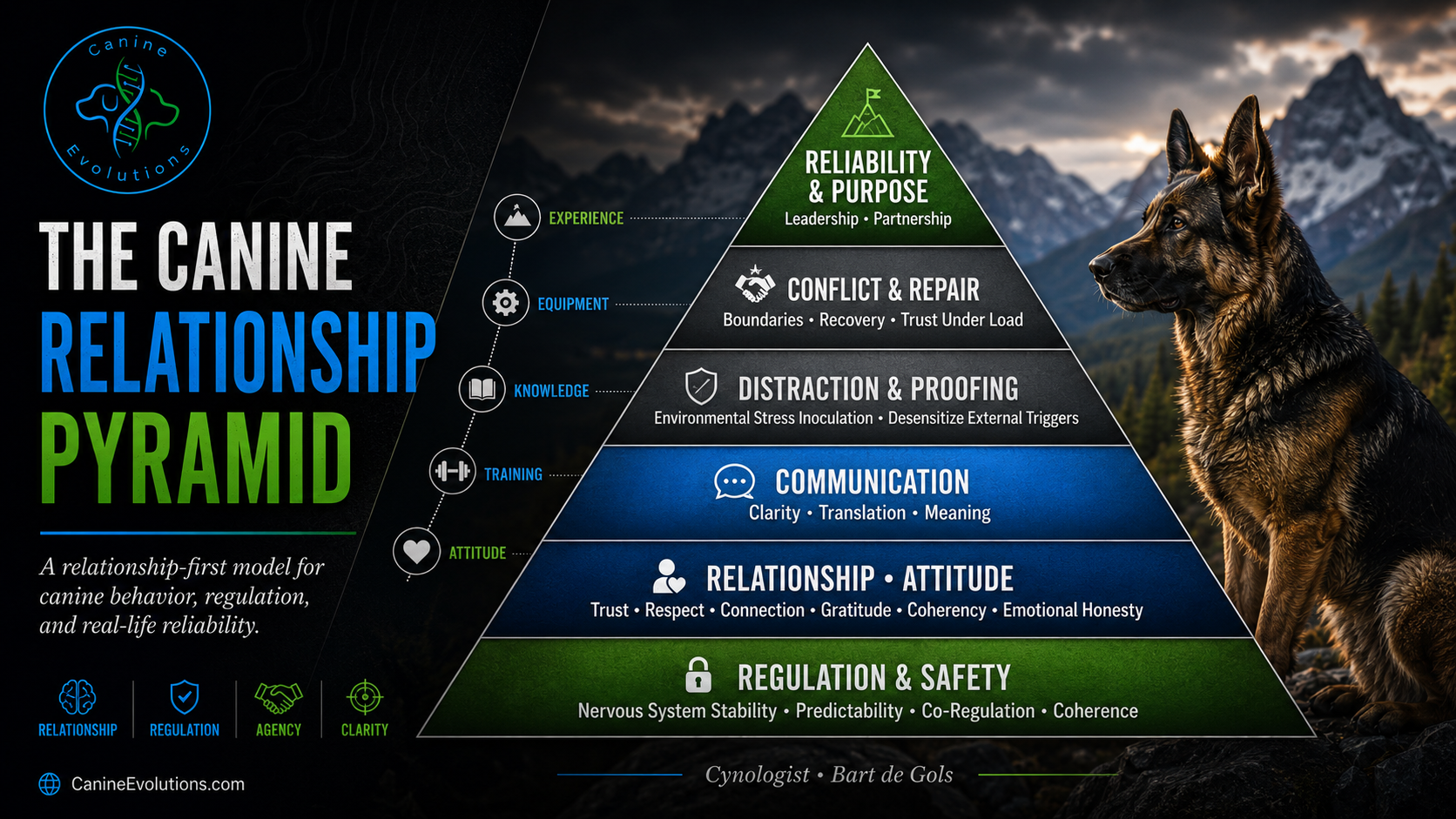
The Canine Performance Pyramid™
The heart of my work is a model I created called the Canine Performance Pyramid™—a roadmap that moves a dog from instinctive survival toward calm, cognitive partnership.
Too often people start at the top: they push obedience, corrections, or protocols while the dog’s nervous system is still in fight-or-flight. That approach fails because when a dog is flooded, the brain’s learning and inhibition systems cannot do their job.
Real change begins at the base.
Relationship Phase
We build trust, respect, and joy before we demand performance. Stress lowers. Learning becomes available.
Teaching Phase
We build a shared language through timing, clarity, and meaning.
Training Phase
We develop practical skills for real life: leash walking, settling, manners, household structure, service tasks where appropriate.
Distraction Phase
We systematically add challenge while keeping the dog cognitive, not flooded.
Proofing Phase
We generalize skills across real-world environments until reliability becomes reality.
Conflict Phase
Conflict becomes rare when the layers below were built correctly. When conflict appears, we resolve it safely with structure, clarity, and relationship—not chaos.
What I Specialize In
I work with a wide range of dogs, but I am known for cases where people feel stuck, overwhelmed, or out of options, including:
severe reactivity and aggression risk
fear, anxiety, phobias, and trauma patterns
guarding behaviors and conflict inside the home
high-drive working dogs that need clarity and structure
service dog development and long-term task reliability
My goal is never to shut a dog down. My goal is to build a dog that can think—because thinking is where choice begins.
Education Is Part of the Training

Check out our online Course on Udemy
Training doesn’t only happen during sessions. It happens in everyday moments—how you enter a doorway, how you hold the leash, how you move through pressure, how consistent your state is, and how predictable your leadership feels to the dog.
That’s why Canine Evolutions is not only a training center. It is also an educational ecosystem:
Workshops & Seminars based on my three books (two-day formats)
an online foundation course on Udemy: From Tyrant to Teacher
a free article library for owners who want depth and clarity
How to Start
If you want to work with me, we begin with an evaluation. Not because I want to slow you down—because guessing costs people money, time, and setbacks.
An evaluation lets me see the full picture: your dog’s stress patterns, triggers, recovery, handling mechanics, and the most realistic path forward—private coaching, a behavior plan, board & train, or long-term coaching.
So START HERE
“No one has a right to consume the happiness of his dog without producing it. Training is a serious business but don’t forget to be happy in what you are doing, be consistent in your training, body language. Be focussed, serious and dedicated but sometimes, Just play. Have fun. Enjoy the game.”