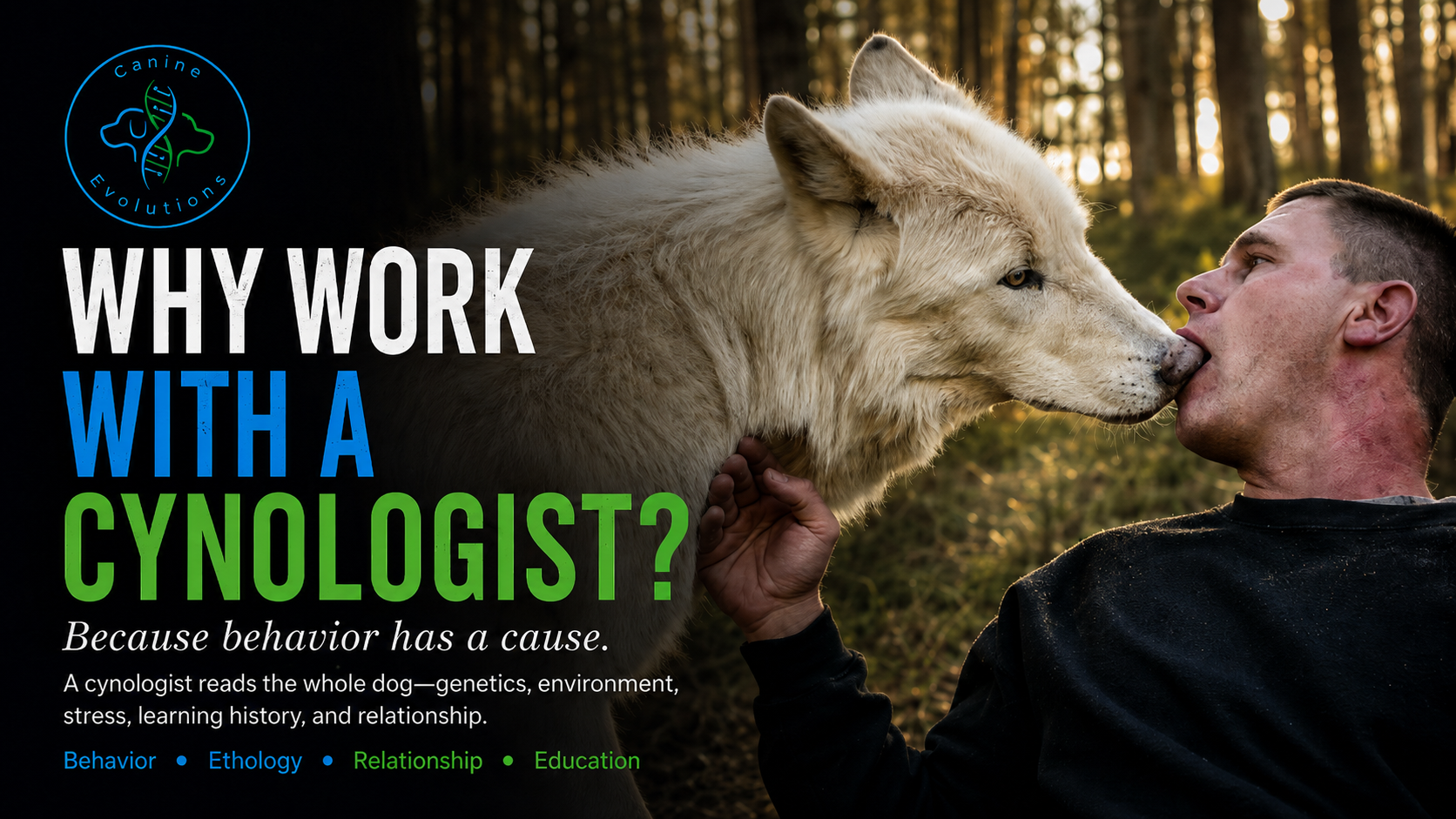
Why Work With a Cynologist?
When your dog’s behavior is more than “obedience”—when you’re dealing with reactivity, aggression, anxiety, fear, phobias, or a dog that seems unpredictable—what you need is not a quick technique. You need someone who can read the whole picture and build a plan that actually fits the dog in front of you.
That’s what cynology is.
A cynologist doesn’t just teach behaviors. A cynologist studies the dog as a species and as an individual—how genetics, environment, stress, learning history, and social dynamics shape behavior. That depth matters most when the case is complex, because complex cases don’t respond to one-size-fits-all training.
Behavior Has a Cause
Many people have already tried training by the time they find me. The dog may even “know the commands,” yet the problem is still there—because the command was never the issue.
Reactive dogs are often overwhelmed. Aggressive dogs are often operating from fear, conflict, guarding patterns, or repeated rehearsal. An anxious dog may be living in a constant state of hypervigilance. A phobic dog may be trapped in panic cycles.
If you only treat the surface behavior, the behavior will change shape—but the root cause remains.
My job is to identify what’s driving the behavior beneath the surface and then build change from the inside out: reduce rehearsal, increase stability, rebuild trust, and create new patterns that hold up in real life.
A Plan That Matches Your Dog
No two dogs carry the same nervous system, history, thresholds, or recovery ability. That’s why I don’t run cases by template.
I look at triggers, intensity, and recovery. I look at handling and communication. I look at the home environment and the daily routines that keep the cycle alive.
Then we build a plan that is realistic for your life—not an idealized plan that collapses the moment you go back home.
Behavior Modification Requires Skill and Structure
Behavior cases aren’t fixed by one “good session.” They require structure, progression, and accountability.
That means knowing when to slow down, when to increase difficulty, how to prevent setbacks from turning into disaster, and how to keep the dog’s nervous system from being pushed past its threshold.
And it means teaching the human what to do, because the human is part of the environment the dog is responding to. When the handler becomes clearer, calmer, and more consistent, the dog’s ability to learn expands dramatically.
You Don’t Need More Opinions. You Need Clarity.
If you’re overwhelmed, stuck, or exhausted from trying different advice, this is what working with a cynologist should give you:
clarity about what’s actually driving the behavior
immediate steps to reduce stress and prevent rehearsal
a realistic training path forward (private coaching, behavior plan, board & train, or long-term support)
guidance that holds up outside of a controlled session
Start Here
If you want to work with me, we begin with a New Client Evaluation so I can assess the full picture and recommend the right path.