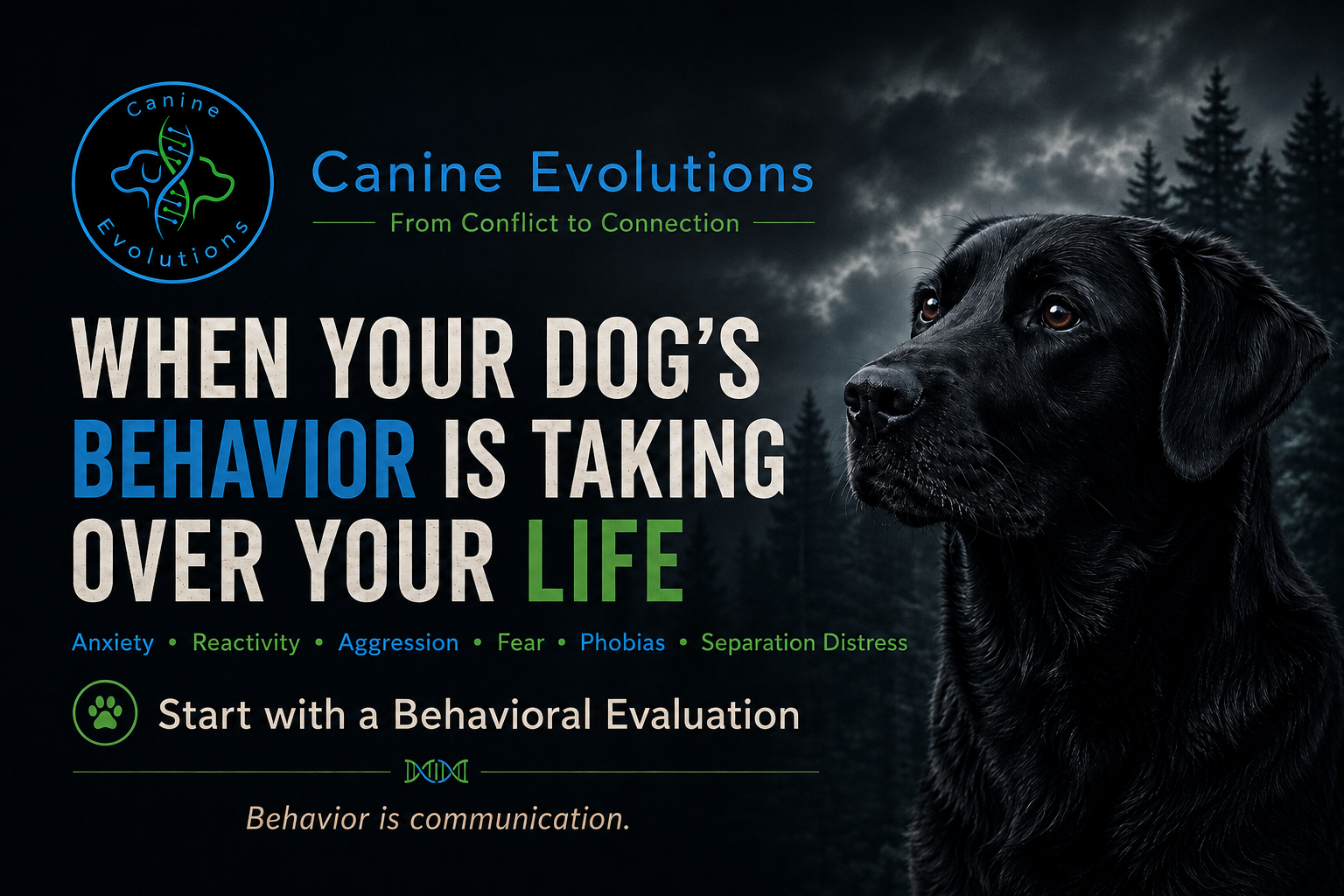
WHEN YOUR DOG’S BEHAVIOR IS TAKING OVER YOUR LIFE
Anxiety • Reactivity • Aggression • Fear • Phobias • Separation Distress
When living with your dog has become stressful, unpredictable, restrictive, or frightening, simply trying another training technique is rarely enough.
At Canine Evolutions, we begin by understanding the dog in front of us—the nervous system, environment, learning history, relationships, genetics, antecedents, and the context in which the behavior occurs.
Because behavior is communication.
Your dog is not simply giving you a hard time.
Your dog may be having a hard time.
START WITH A BEHAVIORAL EVALUATION
SCHEDULE MY BEHAVIORAL EVALUATION
Veterinary referral? You are in the right place.
YOU DON’T HAVE TO KEEP LIVING AROUND THE BEHAVIOR
Maybe you no longer invite people into your home.
Maybe walks have become something you dread.
Maybe your dog panics when you leave, explodes when another dog appears, cannot settle, guards objects or people, or becomes overwhelmed during veterinary visits.
Perhaps you have already tried obedience classes, online advice, medications, corrections, treats, management strategies—or several trainers—and yet something still does not make sense.
That is exactly why we start with an evaluation.
Before deciding how to change a behavior, we need to understand why the behavior is occurring.
WE HELP WITH
Anxiety & Chronic Hypervigilance
Dogs who struggle to settle, constantly scan their environment, startle easily, remain on alert, or appear unable to truly relax.
Reactivity
Explosive or intense responses toward dogs, people, vehicles, movement, sounds, visitors, environments, or other triggers.
Aggression
Growling, snapping, biting, territorial behavior, aggression toward people or dogs, household conflict, and other behaviors affecting safety.
Fear & Phobias
Environmental fear, noise sensitivity, storms, unfamiliar places, people, surfaces, objects, movement, veterinary environments, and other fear-related responses.
Separation-Related Distress
Panic, vocalization, destruction, escape behavior, inability to settle, or significant distress associated with being left alone or separated from a particular person.
Resource Guarding
Food, toys, spaces, furniture, objects, people, entrances, resting areas, or other valued resources.
Veterinary & Handling Fear
Difficulty with examination, restraint, nail care, ears, feet, grooming, muzzle conditioning, body handling, or veterinary procedures.
Multi-Dog & Household Conflict
Tension, fighting, competition, guarding, instability, or deteriorating relationships between dogs living in the same home.
Complex Behavioral Cases
Cases where several behavioral, environmental, relational, medical, developmental, or contextual factors appear to be interacting.
BEHAVIOR RARELY EXISTS IN ISOLATION
A dog can appear completely different depending on where the dog is, who is present, what happened immediately before the behavior, what the dog has learned previously, and what physiological state the dog is experiencing at that moment.
That is why simply labeling a dog “aggressive,” “anxious,” “dominant,” or “reactive” tells us very little.
At Canine Evolutions, we look at the whole picture.
We examine factors such as:
Nervous-system state and ability to regulate
Environmental triggers
Learning history
Antecedents and behavioral patterns
Human-dog interaction
Relationship dynamics
Genetics and temperament
Developmental history
Sleep, activity, routine, and recovery
Previous training
Context-specific behavior
Potential medical contributors
The goal is not merely to stop what the dog is doing.
The goal is to understand what is driving it so meaningful, sustainable change becomes possible.
WHAT HAPPENS DURING A BEHAVIORAL EVALUATION?
1. We Listen
We begin with the history.
What happened? When did it begin? Where does it occur? What makes it better? What makes it worse? What has already been tried?
Your experience matters because you live with the dog every day.
2. We Observe
We look beyond obedience.
We observe behavior, arousal, recovery, environmental awareness, social interaction, communication, coping strategies, and the relationship between dog and human.
3. We Identify Contributing Factors
We begin separating symptoms from underlying causes and identifying the factors maintaining or intensifying the behavior.
4. We Build a Direction Forward
After the evaluation, you will have a clearer understanding of what is happening and what the next appropriate steps should be.
Depending on the dog, those recommendations may include private coaching, environmental changes, relationship work, structured behavior intervention, immersion training, cooperative-care work, veterinary collaboration, or another individualized approach.
Not every dog needs the same program.
That is exactly why the evaluation comes first.
WORKING TOGETHER WITH YOUR VETERINARIAN
Behavior and physical health are not separate worlds.
Pain, neurological changes, endocrine conditions, gastrointestinal discomfort, medication effects, sensory changes, and other medical factors can influence behavior.
When medical involvement may be relevant, we encourage collaboration with your veterinarian.
If your veterinarian referred you to Canine Evolutions, we are happy to work as part of that larger care team when appropriate and with your permission.
Behavioral intervention complements veterinary medicine. It does not replace it.
If your dog’s behavior has changed suddenly or dramatically, please speak with your veterinarian about possible medical causes.
FROM CONFLICT TO CONNECTION
Living with serious behavioral problems changes more than the dog.
It changes your routines.
Your relationships.
Your home.
Where you can go.
Who can visit.
Whether you can travel.
Whether you feel safe.
Sometimes even whether you still enjoy living with the dog you love.
Our work is not about creating mechanical obedience.
It is about helping dogs and humans understand one another better, reducing unnecessary conflict, creating regulation and predictability, and rebuilding a relationship in which both can function more successfully.
That is the path from conflict to connection.
YOUR FIRST STEP IS NOT A TRAINING PACKAGE.
IT IS UNDERSTANDING YOUR DOG.
You do not need to decide today whether your dog needs private training, an intensive program, long-term support, or something else.
That comes later.
Start with the question that matters first:
What is actually happening with my dog?
REQUEST YOUR BEHAVIORAL EVALUATION
Please complete the form below. Tell us what is happening, what concerns you most, and what you would like life with your dog to look like.
We will review your information and contact you regarding the next step.
Form Fields
Your Name*
Email Address*
Phone Number*
Dog’s Name*
Dog’s Age
Breed / Breed Mix
What concerns you most?*
Select all that apply:
Anxiety
Reactivity
Aggression
Separation Distress
Fear / Phobias
Resource Guarding
Veterinary / Handling Fear
Multi-Dog Conflict
Other
Please describe what is happening.*
When does the behavior occur? What does it look like? How long has it been happening?
Has your dog bitten a person or another animal?*
Yes
No
Are you currently working with a veterinarian regarding this behavior?
Yes
No
Veterinary Clinic
Optional
What would you most like to change?
How did you hear about Canine Evolutions?
Veterinarian
Current/Past Client
Google
Facebook
Friend/Family
Other
[ REQUEST MY BEHAVIORAL EVALUATION ]
Hidden Tracking Fields
Clinic
Default: website
Material
Default: landing-page
These fields are not visible to the visitor and can be populated automatically by clinic-specific referral links and QR codes.
CANINE EVOLUTIONS
Bart de Gols, Cynologist
241 Rakoz Rd.
Toledo, WA 98591
360-469-3171
info@canineevolutions.com
www.canineevolutions.com
From Conflict to Connection