
cognition

Reactivity vs. Aggression: The Neuroscience of Canine Outbursts

Reactivity vs. Aggression: The Neuroscience of Canine Outbursts

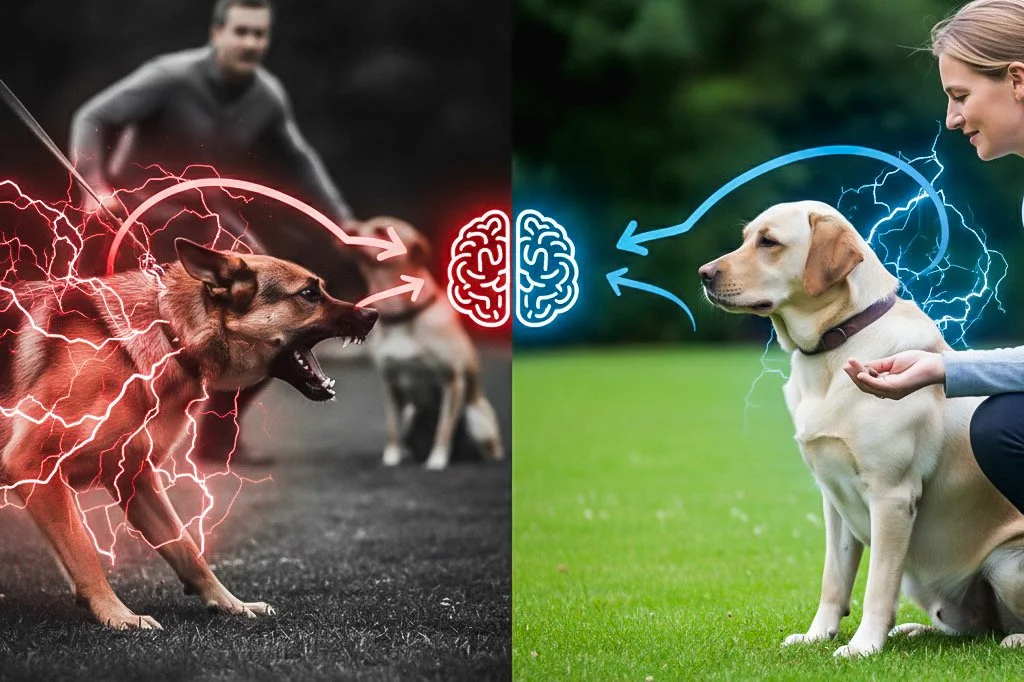
The most catastrophic misdiagnosis I see in my work is the conflation of reactivity with aggression. One is a physiological reflex; the other is a learned strategy. In this article, I dissect the critical neurological difference between what I call the Primal Mind—the reflexive, amygdala-driven survival system—and the Cognitive Mind, which is the prefrontal cortex, the center of decision-making and intention. A reactive dog is a dog whose Primal Mind has hijacked its nervous system, often due to a high allostatic (stress) load, leaving it drowning in cortisol and unable to access its 'thinking' brain.

I also explore the tragic slide of how chronic, unmanaged reactivity becomes learned aggression, and how the handler's own nervous system—our own stress and tension—creates a devastating neuroceptive feedback loop that co-regulates our dog's panic. Understanding this biology is not academic; it is the only way to formulate a correct intervention. I provide the specific neurological protocols for both: how we rewire the Primal Mind's emotional association using counter-conditioning, and how we reroute the Cognitive Mind's learned strategy using a combination of differential reinforcement and safe, non-confrontational negative punishment. This is the science of moving from chaos to clarity.

More Than a Nap: The Essential Role of Sleep in Canine Health and Happiness

More Than a Nap: The Essential Role of Sleep in Canine Health and Happiness

As a cynologist, I can’t emphasize enough how vital sleep is for dogs, playing a role as crucial to their well-being as it does for humans. Sleep serves as a cornerstone for a dog’s physical health, emotional stability, and cognitive functioning. Yet, in my experience, many pet owners often overlook the importance of quality sleep for their canine companions, unknowingly fostering environments that disrupt their dog’s rest. Just as we need adequate sleep to process daily experiences and maintain balance, so do our dogs. However, unlike humans, dogs don’t typically experience extended, uninterrupted periods of sleep; instead, they rely on frequent, shorter cycles of rest throughout the day and night to stay in equilibrium. When this delicate balance is disrupted, a host of behavioral issues can arise, from mild irritability to severe anxiety.

Often, when I see behavioral issues in dogs, they’re attributed to things like a lack of exercise, insufficient training, or stress in the environment. What goes unnoticed, however, is how frequently sleep deprivation is an underlying factor. A dog that appears hyperactive, reactive, or even destructive may, in fact, be sleep-deprived and simply unable to regulate its emotions and impulses. This connection between sleep and behavior becomes especially crucial with high-energy breeds and working dogs, who need significant time to mentally and physically recover. When these dogs don’t get enough rest, their overstimulated minds and bodies fail to reset, leading to impulsive and problematic behaviors that only escalate over time.

The impact of sleep deprivation doesn’t just stop at behavior—it can take a serious toll on a dog’s overall health. Chronic lack of sleep affects memory, weakens the immune system, and often leads to emotional instability, making dogs more vulnerable to fear-based reactions and even aggression. In sleep, dogs consolidate memories and process learning; when they don’t get enough rest, their ability to retain training and recall commands is compromised. Over time, these effects compound, creating a vicious cycle in which sleep-deprived dogs become increasingly difficult to manage, frustrating owners who are unaware of the root cause.

In this article, I’ll take you through the profound role that sleep plays in a dog’s life and its direct connection to behavioral health. I will explain the biological, neurological, and psychological dimensions of canine sleep to offer a comprehensive understanding of how lack of rest can drive behavioral issues. Additionally, I’ll share practical strategies for promoting better sleep hygiene in dogs, helping you recognize signs of sleep deprivation and foster environments where restful sleep is possible.

Mind Over Manner: From Behavioral Conditioning to Cognitive Mind State Management

Mind Over Manner: From Behavioral Conditioning to Cognitive Mind State Management

In this article, I present my approach to dog training that moves beyond traditional behavioral conditioning to embrace the complex neuroscience of canine cognition. Through the years I've discovered that successful training isn't merely about teaching and reinforcing behaviors—it's about understanding and managing the dog's brain state to optimize learning and promote lasting behavioral change. This paradigm shift represents a fundamental departure from conventional training methods, offering a more sophisticated and scientifically-grounded approach to canine behavior modification.

At the heart of this methodology lies the recognition of what I call the "two minds" of the dog—the cognitive mind and the primal mind. This duality, rooted in the interplay between the prefrontal cortex and limbic system, forms the cornerstone of modern canine behavior understanding. Through careful observation and documentation of hundreds of cases, I've developed protocols that allow us to identify, influence, and maintain optimal brain states for learning. When we understand how to manage these states effectively, we can achieve behavioral changes that are both more profound and more sustainable than those obtained through traditional training methods.

The implications of this neuroscientific approach extend far beyond simple obedience training. By understanding the biological mechanisms that drive behavior—from neurotransmitter balance to cortisol management—we can create training environments that work with, rather than against, the dog's natural neurological processes. Throughout this article, I will guide you through the practical applications of these principles, sharing detailed protocols and case studies that demonstrate how this understanding transforms our ability to address complex behavioral challenges. When we shift our focus from external compliance to internal state management, we open new possibilities for creating lasting positive change in our dogs' lives.