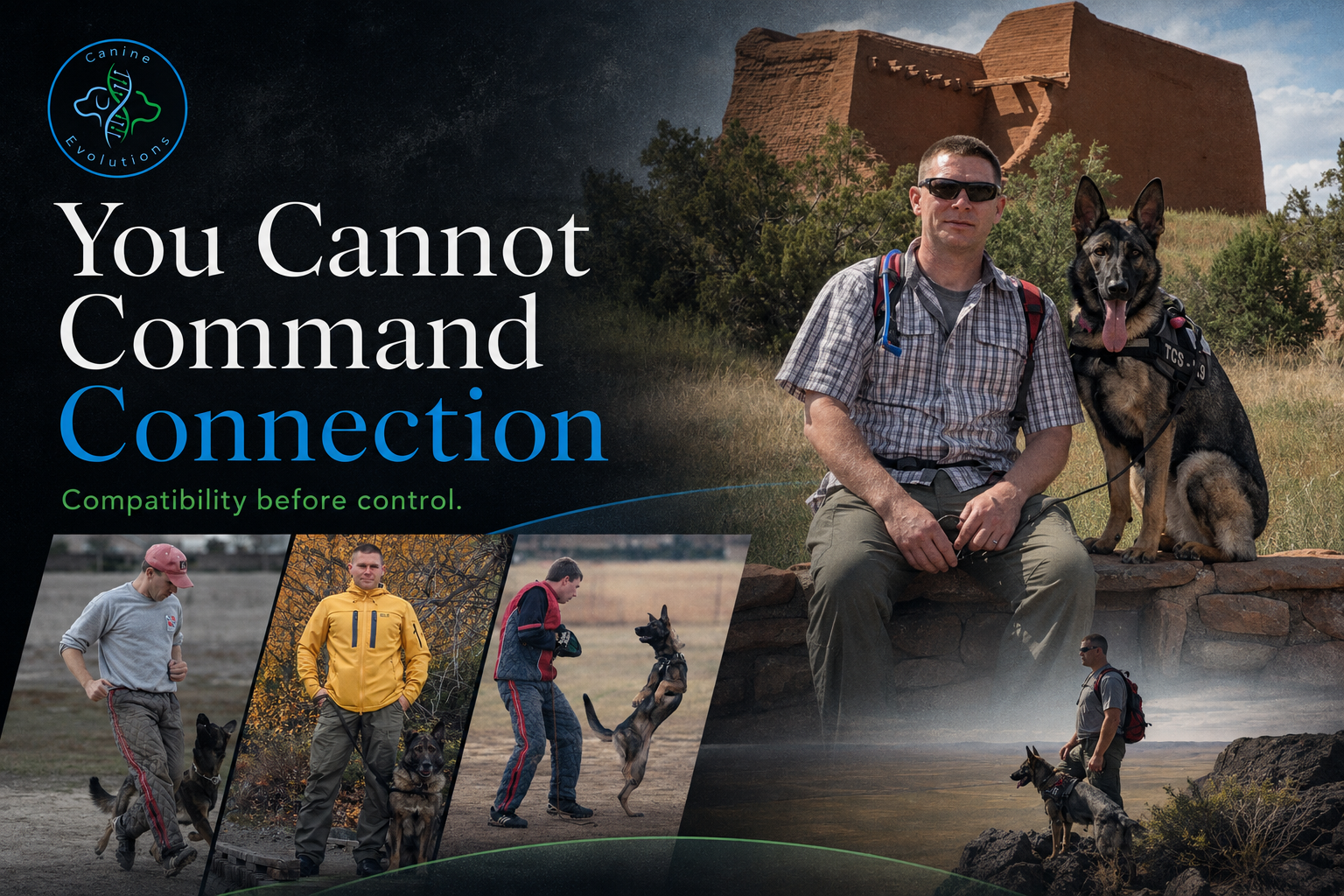
You Cannot Command Connection
When love, ownership, and compatibility are not the same thing
There is a particular kind of sadness I have witnessed throughout my career that is difficult to explain to people who still believe dog training is primarily about obedience, because it does not begin with aggression, disobedience, reactivity, pulling on the leash, failed recalls, or any of the other visible behaviors that eventually bring someone through my door. Those things are often merely the debris left behind by something that began much earlier and much more quietly, in the space between a human being and a dog who, despite sharing a home, a routine, a family, and perhaps even many years together, were never particularly well suited to one another in the first place.
I see this far more often than most people would imagine, and the mismatch can take countless forms. Sometimes a human wants an athletic dog who will move through life beside them with energy and enthusiasm, but brings home an animal whose greatest pleasure is lying in a patch of sunlight and observing the world from a safe and comfortable distance. Sometimes a person longs for a deeply affectionate companion and chooses a dog whose temperament is naturally more reserved, selective, independent, or suspicious of prolonged social contact. Sometimes a quiet and relatively sedentary household brings home an extraordinarily intense working dog whose nervous system seems to live several revolutions per minute faster than the people around it, while in other homes the opposite occurs, with active, demanding people becoming frustrated with a dog who simply does not possess the drive, resilience, stamina, or desire to participate in the life they imagined.
There are dogs who need enormous amounts of mental engagement, dogs who require substantial physical work, dogs who need predictability and routine, dogs who thrive on novelty, dogs who want to be close to their humans nearly all the time, and dogs who are perfectly content maintaining a degree of social distance that many people interpret as rejection. There are humans who love this intensity and humans who find it exhausting, humans who enjoy training as a daily conversation and humans who would prefer a dog who comfortably disappears into the rhythm of the household without asking very much in return. None of those preferences are inherently wrong, and none of those dogs are inherently better or worse than the others, but when the needs, temperament, expectations, and rhythms on both sides fail to align, the relationship can slowly become something very different from what either species would naturally have chosen.
What makes this particularly difficult is that we seem perfectly capable of understanding compatibility almost everywhere else in human life. We understand that two good people can make terrible spouses, that two intelligent people can make miserable business partners, that a person can be kind and thoughtful and still be the wrong roommate, travel companion, colleague, or friend for someone else. We acknowledge that personality matters, that energy matters, that values matter, that tolerance matters, that lifestyle matters, and that relationships become strained when the people involved are continuously required to suppress themselves in order to remain together. Yet somehow, when it comes to dogs, we have developed the strange belief that compatibility should become irrelevant the moment ownership begins.
Once the dog has been purchased, adopted, selected, rescued, or brought into the home, an invisible contract seems to appear in the human imagination in which the dog is now expected to become compatible with the life already waiting for it. Instead of asking whether the relationship itself makes sense, we often assume that any friction can and should be corrected through training, structure, repetition, discipline, management, or control. The dog may be too intense, too independent, too sensitive, too socially selective, too environmentally reactive, too physically demanding, too mentally demanding, or simply too different from the person who chose it, but rather than considering whether this difference is meaningful, we tend to frame the entire problem as something the dog needs to overcome.
This is where the relationship often begins to change.
At first, the human may simply ask for more attention, more engagement, more proximity, more affection, or more responsiveness, but when those things do not emerge naturally, the asking becomes increasingly deliberate. The dog is called more often, redirected more often, corrected more often, positioned more often, and increasingly prevented from making choices that might lead it away from the human. Attention begins to be treated as a duty rather than something that develops through relevance, safety, curiosity, and voluntary engagement. The person may become frustrated that the dog is looking elsewhere, interested in something else, avoiding physical contact, ignoring attempts at play, or simply failing to express attachment in the particular form the owner expected when they first imagined what life with this dog would look like.
What began as a desire for relationship can gradually become a demand for evidence that the relationship exists.
That is a very important distinction, because there is a tremendous difference between a dog who chooses to orient toward you and a dog who has learned that failing to orient toward you produces consequences. There is a difference between the dog who seeks your presence because you have become relevant within its emotional and social world and the dog who remains close because every attempt to disengage has been interrupted. There is a difference between voluntary attention and enforced attention, just as there is a difference between trust and compliance, even though the two can sometimes look remarkably similar from the outside.
This is one of the places where traditional dog training has often failed us, because behavior is much easier to measure than relationship. We can count repetitions, duration, latency, distance, accuracy, and response to cues, but none of those things necessarily tell us how the dog feels about the person who is giving them. A dog can perform extraordinary obedience for someone with whom it has a shallow or conflicted relationship, just as another dog may possess a profound attachment to its human while performing relatively unimpressive formal obedience. When we confuse the performance of behavior with the quality of relationship, it becomes very easy to believe that a dog who is compliant must also be connected.
I have never believed those things to be synonymous.
The relationship I am interested in emerges when the dog begins to choose the human even when other possibilities exist, because the human has become meaningful within the animal’s nervous system rather than merely unavoidable within its environment. I am interested in the moment curiosity replaces avoidance, in the moment the dog begins voluntarily checking in, in the moment proximity develops because it feels worthwhile rather than because it has been demanded, and in the moment the dog discovers that interacting with a human being can provide information, safety, opportunity, regulation, and agency rather than simply restriction.
That kind of relationship cannot be forced into existence in the same way a behavior can be reinforced or suppressed. We can certainly compel an animal to sit, remain beside us, stop moving, hold eye contact, walk in a particular position, or return when called, but those behaviors alone cannot tell us whether the dog trusts us, enjoys us, feels safe with us, or has any genuine desire to participate with us beyond avoiding what happens when it does not. Trust is not something we can command from another nervous system, affection cannot be extracted through repetition, and connection cannot be manufactured merely by removing every alternative to engagement.
This becomes especially important when people choose dogs whose fundamental temperament conflicts with their own expectations. A naturally reserved dog may never become the socially effusive companion its owner imagined. A genetically intense working dog may never become content with a life built around a short walk and an otherwise quiet household. A highly environmentally sensitive animal may struggle profoundly in a home filled with children, visitors, noise, movement, travel, and constant unpredictability, while a dog who thrives on stimulation may deteriorate in an environment that offers almost none. A person who wants constant physical affection may experience the independence of a particular dog as rejection, while the dog may experience the person’s relentless attempts at closeness as social pressure.
None of this requires villains. Sometimes the human is trying very hard, the dog is trying very hard, and the relationship remains difficult because effort cannot always erase incompatibility.
That idea is deeply uncomfortable in modern dog culture, because we have romanticized the notion that enough love, enough training, enough commitment, or enough determination can make every pairing successful. We have created a moral framework in which keeping the dog is almost always interpreted as virtuous while admitting incompatibility is interpreted as failure, selfishness, or abandonment, yet life is rarely that simple. There is an enormous difference between discarding a dog because ownership became inconvenient and acknowledging, after honest reflection and responsible effort, that the life being offered may never truly suit the animal standing in front of you.
The difficulty is that human ego becomes heavily invested in proving that we can make the relationship work. Once that happens, the dog’s behavior stops being information and starts becoming opposition. We no longer look at avoidance and wonder why the dog is avoiding us; we decide the dog must learn not to. We no longer look at chronic overstimulation and ask whether the dog’s environment is fundamentally wrong for its nervous system; we decide the dog needs more impulse control. We no longer consider whether the animal’s social preferences are compatible with our expectations; we begin teaching the dog that disengagement is unacceptable. Gradually, the human becomes more controlling, more insistent, and more focused on obedience precisely because the natural relationship they hoped for never materialized.
This is where I believe we need to become much more courageous in the way we look at dogs, because there are moments when the most important question is not, “How do I make this dog do what I want?” but rather, “Who is this dog, and what kind of life would allow this animal to flourish?”
That question requires us to look beyond breed labels and beyond the romantic stories we tell ourselves about what a dog should become. Dogs arrive carrying genetics shaped across generations, developmental experiences that influence how the nervous system interprets the world, inherited tendencies toward sociability, suspicion, persistence, environmental sensitivity, frustration tolerance, prey interest, movement, exploration, recovery, and countless other traits that exist long before formal training begins. On top of that biological inheritance sits the individual animal, with a personality that cannot simply be reduced to breed or training history.
Some dogs move toward novelty while others need time to study it. Some are immediately social while others prefer selective relationships. Some recover almost instantly from environmental pressure while others carry the physiological residue of stress for hours. Some dogs seem to awaken every morning asking what work needs to be done, while others are perfectly satisfied by a life of moderate engagement, familiarity, and rest. Some need substantial physical expression to remain regulated, while others become dysregulated when constantly stimulated. These differences are not character flaws, and they are not evidence that one dog is superior to another, but they matter enormously when we decide where and with whom that dog should live.
The same is true for humans, although we often refuse to examine ourselves with the same honesty. There are people who genuinely enjoy living with intensity and people who only admire intensity from a distance. There are people who love spending hours training and people who become irritated by the thought of repeating the same exercise for five minutes. There are humans who flourish in constant movement, humans who need quiet, humans who adore physical affection, humans who require personal space, humans who are naturally predictable, and humans whose lives are beautifully chaotic. There are people who want a dog intertwined with nearly every part of their day and people who want a companion who is content simply existing nearby.
The problem is not that any of those people are wrong; the problem begins when we choose dogs based on the person we imagine ourselves to be rather than the person we actually are.
Someone may fall in love with the image of owning a powerful working breed because the dog represents strength, competence, athleticism, or discipline, while their actual daily life leaves very little room for the animal’s needs. Someone may select a livestock guardian because they admire its dignity and independence, only to discover that independence feels intolerable once it appears inside their own home. Someone may choose a highly social breed and later resent the constant desire for proximity, while another person chooses a naturally aloof dog and spends years attempting to turn it into an animal who seeks affection on command.
We increasingly choose dogs aesthetically and then attempt to solve temperament afterward. That is an extraordinarily expensive mistake, not merely in money or training hours, but in the emotional lives of both species.
When the mismatch becomes chronic, the household often enters a pattern of perpetual negotiation. The human becomes increasingly frustrated that the dog will not behave in accordance with the imagined relationship, while the dog experiences more restrictions because its natural tendencies continue creating conflict. Eventually, enormous amounts of effort are spent reducing the dog rather than understanding it. Exploration is restricted, movement is restricted, social expression is restricted, environmental choice is restricted, and autonomy is gradually narrowed until the animal becomes easier to manage.
Yet manageability is a very low standard for a relationship.
I want more for dogs than simply becoming tolerable enough to remain in someone’s house, and I want more for people than spending ten or twelve years perpetually fighting the temperament of the animal sleeping in their living room. The right pairing does not eliminate training, frustration, adolescence, conflict, or responsibility, but it changes the nature of those challenges because the relationship itself is moving in the same general direction. The dog’s needs resemble the life the human naturally wants to provide, while the human’s expectations resemble the kind of relationship the dog is capable of offering.
When this happens, there is a certain ease in the relationship that should not be confused with laziness or lack of structure. Training still exists, boundaries still matter, and responsibility remains essential, but there is less need to continually suppress the animal because the dog’s basic nature is not perpetually colliding with the household. The person does not spend every day trying to manufacture a different dog, and the dog does not spend every day being told that the dog it naturally is happens to be wrong.
This kind of compatibility used to exist almost accidentally when dogs were selected more frequently for function. A shepherd chose dogs whose behavioral tendencies suited livestock work, a hunter chose animals whose drives aligned with hunting, and working partnerships were built around the fact that the dog’s inherited characteristics were useful within the human environment. Modern dog ownership has increasingly separated selection from function, which means people often choose animals based on appearance, reputation, childhood memories, popular culture, social media, or emotional attraction while giving relatively little consideration to whether the actual dog fits the actual life waiting at home.
This is why I believe dog selection should begin with uncomfortable honesty rather than aspiration.
Before asking what breed you want, it may be far more useful to ask what kind of human you actually are. How much activity do you genuinely enjoy when the weather is bad, when work is demanding, when winter arrives, and when the novelty of owning the dog has long disappeared? How much time do you truly want to spend training, structuring, engaging, and providing outlets for behavior? How much physical affection do you expect from an animal, how much independence can you tolerate, how frequently do strangers enter your home, how much unpredictability exists within your family, and how capable are you of living with a dog whose nervous system may require more regulation, more work, more space, more predictability, or more patience than you initially imagined?
These questions are far more important than whether someone likes the shape of a particular breed’s head.
They also require us to stop treating self-knowledge as an insult. There is nothing shameful about wanting a calm dog, nothing inferior about wanting an active one, nothing wrong with admitting that you do not enjoy spending several hours each day providing structured mental work, and nothing arrogant about saying that you do. There is no moral superiority in choosing the most difficult dog you can possibly manage, just as there is no virtue in selecting an animal whose needs will overwhelm you merely because the breed carries a particular cultural image.
The shame, if there is any, lies in refusing to know ourselves while asking another living being to pay for that refusal.
This is where the mirror becomes more important than the leash.
When compatibility does exist, training becomes something very different. Instead of a continuous attempt to force the dog into a predetermined shape, it becomes a conversation between two individuals who are gradually learning how to move through the world together. Structure becomes guidance rather than imprisonment, boundaries can exist without constant conflict, and the dog’s agency no longer feels threatening because the relationship does not depend on controlling every decision the animal makes.
Perhaps most importantly, the person begins to see the dog rather than the fantasy that preceded it.
That distinction matters enormously to me, because there is something almost sacred in allowing another living being to remain itself while still learning how to live successfully beside us. The dog is not a blank slate, not an extension of our identity, not a symbol of our competence, and not an emotional appliance whose purpose is to produce affection whenever we request it. The dog is another organism carrying its own nervous system through a human environment it did not design, continuously attempting to understand rules, expectations, pressures, rewards, threats, opportunities, and relationships created by another species.
If we truly want connection with that animal, then we must eventually become interested in what the dog is communicating rather than merely how effectively we can make the communication stop.
Sometimes that means changing our expectations. Sometimes it means providing a different amount or kind of work. Sometimes it means altering the environment, reconsidering routines, becoming more regulated ourselves, learning how much social pressure we unknowingly create, or accepting that the form of affection the dog offers may not resemble the form we originally wanted.
There are many relationships that can transform dramatically when the human is willing to make those changes, and I have spent much of my career helping people discover that possibility. I do not believe difficulty automatically means incompatibility, and I certainly do not believe dogs should be rehomed because adolescence becomes frustrating, because a training problem requires effort, or because life with an animal turns out to be less convenient than expected. Commitment matters enormously, and anyone bringing a dog into their life accepts a profound responsibility for that animal.
However, responsibility should never become confused with possession.
There are circumstances in which the most responsible act may eventually be acknowledging that the relationship itself is wrong, particularly when years of conflict, chronic stress, unmet needs, suppression, management, and escalating control have produced a life in which neither the dog nor the human is flourishing. In those situations, thoughtfully finding a more compatible home is not automatically abandonment, just as keeping a dog indefinitely is not automatically proof of love.
We should be very cautious about congratulating ourselves for lifelong ownership if the life itself consists primarily of frustration, isolation, correction, restriction, resentment, and a constant attempt to make the dog into something it never was.
The meaningful question is not simply whether the dog remained in the same home until death, but what kind of life the dog experienced while it was there.
I have watched dogs struggle profoundly in one relationship and become almost unrecognizable in another, not because some magical training technique suddenly appeared, but because the new relationship finally made sense. The person naturally enjoyed what that dog naturally offered, the environment provided what the dog’s nervous system required, and the dog’s temperament no longer needed to be perpetually corrected simply because it existed.
When that happens, something extraordinary becomes visible, because the reduction in conflict creates room for relationship. The human no longer needs to manufacture attention because the dog begins offering it. The dog no longer needs to be constantly controlled because the environment and the partnership themselves make more behavioral sense. What previously looked like stubbornness, disobedience, emotional distance, or chronic conflict can sometimes soften simply because the animal is finally living beside someone whose rhythm resembles its own.
This does not mean every relationship should be easy, nor does it mean we should abandon dogs the moment things become difficult. Some of the most meaningful relationships in my life have required tremendous patience, adaptation, and rebuilding. There are relationships worth fighting for, and there are dogs who teach us more about ourselves precisely because they do not arrive in an easy package.
What matters is being able to distinguish a relationship that is difficult because growth is occurring from one that remains difficult because two individuals are fundamentally pulling one another in opposite directions.
That distinction requires humility.
It also requires releasing one of the most deeply rooted assumptions in dog ownership, which is that love gives us the right to insist on reciprocity in whatever form we desire. We may love a dog deeply and still not be the person that dog would choose if choice were genuinely available. We may provide excellent care and still be unable to provide the life that most naturally suits the animal. We may be competent, ethical, committed, and well intentioned while still being the wrong match.
There is no humiliation in recognizing that truth. The humiliation comes when ego becomes more important than the animal.
There will always be people who respond to incompatibility by increasing control, because control temporarily protects us from the painful possibility that the relationship may never become what we hoped. It is easier to buy another tool, impose another rule, increase pressure, and demand another repetition than it is to sit quietly with the possibility that the dog may simply not want the same relationship we want.
Yet if our goal is truly relationship rather than obedience alone, then we must allow the dog’s preferences to contain information.
We must learn to distinguish the animal who is confused from the animal who is overwhelmed, the dog who lacks clarity from the dog who lacks compatibility, the dog who needs guidance from the dog whose entire life has been structured around demands that contradict its nature. We must become better at asking whether our training is teaching the dog how to live successfully with us or merely teaching the dog that resistance is futile.
I have never been particularly interested in proving to a dog who is in charge. I am far more interested in what the dog learns about me when things become difficult.
Does the dog learn that I am predictable, that I can regulate myself, that I notice what the animal is communicating, that I can provide information without adding unnecessary conflict, and that being near me increases understanding rather than pressure? Does the dog learn that I can create boundaries without becoming emotionally unstable, that I am capable of hearing “not yet” without immediately transforming it into “you must,” and that my presence within an uncertain environment carries some degree of safety?
Those are the things from which relationship is built.
They emerge through thousands of small exchanges in which two nervous systems gradually learn one another, and when compatibility exists beneath those exchanges, the relationship can become extraordinarily deep because neither side is continually being asked to disappear.
Sometimes, however, we discover that the language never becomes fluent. That is painful, but pain does not make the truth less valuable.
There are dogs we can love very deeply who might nevertheless flourish more fully beside someone else, just as there are dogs another person cannot seem to understand who enter our own lives and somehow make immediate sense. The difference does not necessarily tell us who is the better person or who is the better trainer. Sometimes it simply tells us something about fit.
Maturity lies in being able to see that without turning it into accusation.
Perhaps that is ultimately the responsibility we accept when we bring a dog into our lives. We do not merely accept responsibility for feeding, housing, training, vaccinating, exercising, and keeping that animal alive. We accept responsibility for continually asking whether the life we are providing makes sense for the living being in front of us, rather than merely insisting that the living being make sense for the life we had already planned.
Sometimes the answer will require us to change ourselves. Sometimes it will require us to change the environment, our expectations, our routines, or our understanding of the dog. Sometimes the answer will ask us to work harder, become more patient, learn more, and give the relationship enough time to develop beyond the fantasy with which it began.
And sometimes, in the rare but very real circumstances where all of that has been honestly attempted and the relationship remains one of chronic conflict, the most loving decision may be the one our ego resists most strongly.
It may mean finding the place where the dog finally makes sense.
It may mean finding the human whose rhythm matches the animal’s rhythm, whose expectations fit what the dog naturally offers, and whose life allows those traits to become strengths rather than problems that must be corrected every day.
That kind of decision should never be casual, but neither should it automatically be condemned.
There is a form of love that clings because it cannot tolerate loss, and there is another form of love that is capable of asking what is actually best for the other being even when the answer hurts.
The latter is much harder.
Perhaps that is why we so often prefer control.
Control allows us to preserve the story that the relationship belongs to us and therefore must become what we want it to become, whereas genuine connection asks something far more difficult. It asks us to enter the relationship without requiring the other mind to disappear inside our expectations.
That, to me, has always been the most profound space between a human being and a dog.
It is the place where we stop asking how to make the dog love us and begin wondering whether we have become someone the dog can willingly trust, follow, understand, and choose.
When that happens naturally, no amount of control can improve upon it. When it does not happen naturally, no amount of control can truly replace it. And perhaps one of the greatest acts of responsibility in dog ownership is developing enough humility to know the difference.
Bart de Gols
Cynologist